
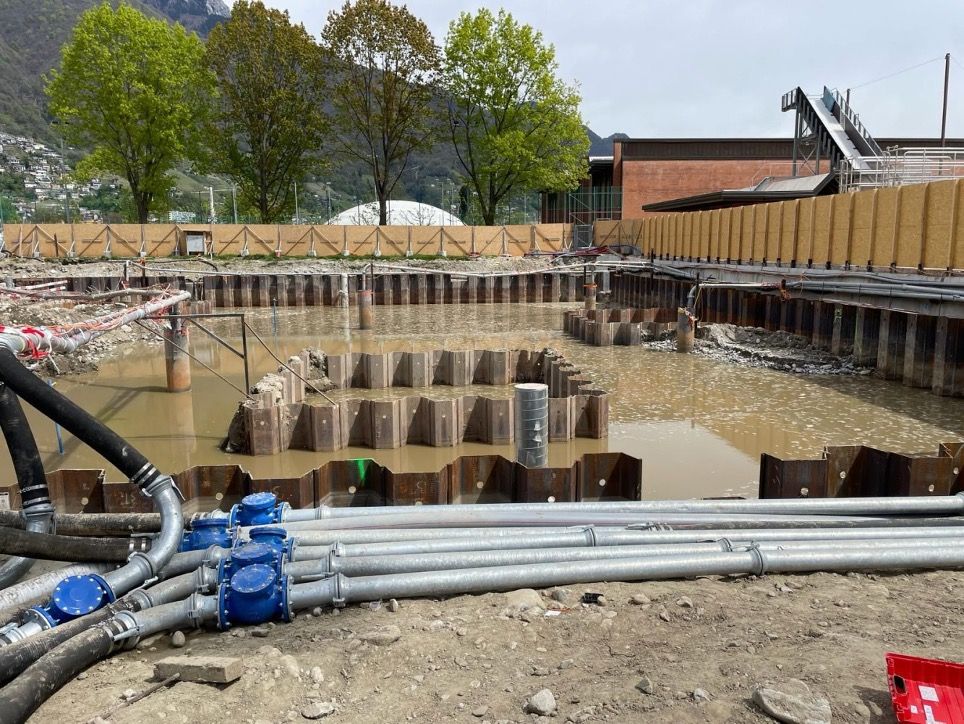
In construction sites with excavations in the water table, excavation drainage (dewatering) cannot be limited to just pumping: it also requires treatment of extracted water and constant monitoring of flow rates to avoid instability, subsidence, and environmental issues. Aquageo has developed an integrated solution for a sports center expansion project, managing drainage, monitoring, and treatment before discharge.
Application Context
-
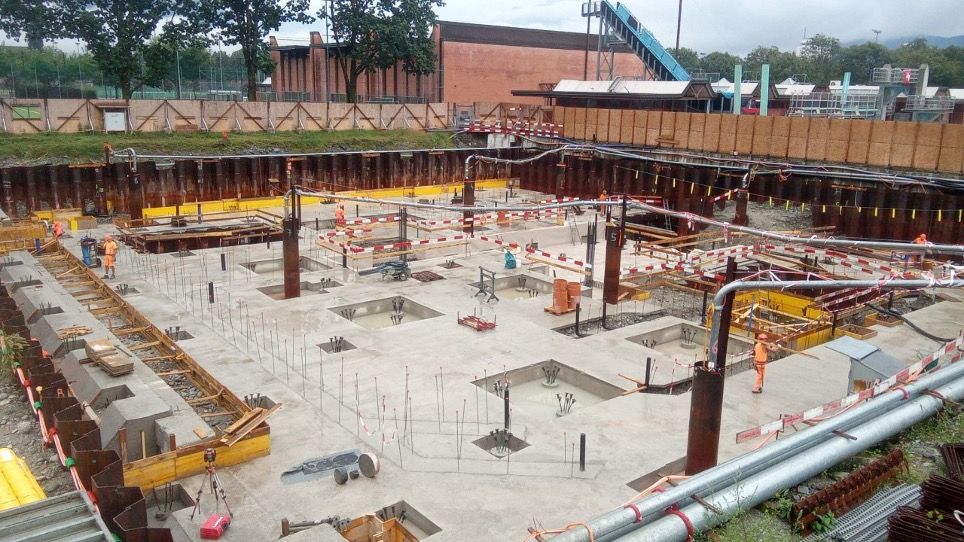
Construction of 4 excavations of 1,800 m² each.
-
Excavations contained by 24 m Larssen sheet piles.
-
Sandy-gravelly soils with a hydraulic head to be lowered by about 2 m.
The challenge: controlling the water table and quality of discharged water
In the presence of permeable soils (a conservative permeability value of about 3.0E-3 m/s), the goal is not only to "lower the water," but to maintain a stable water table level throughout the construction period, without causing over-lowering or uncontrolled variations.
The main requirements were:
-
precisely lowering and controlling the water table in multiple excavation areas;
-
managing high and variable flow rates depending on the hydrometric level;
-
treating the pumped water (turbidity and pH) before release, complying with environmental limits;
-
ensuring operational continuity with a monitored and automated system.
The Aquageo solution: drainage wells, submersible pumps, and multi-stage treatment
Drainage System
A solution with drainage wells was adopted:
-
8 wells with Ø 600 mm
-
8 m depth
-
"bridge" filters and drainage with calibrated gravel 4–8 mm
Pumping and Flow Rate Regulation
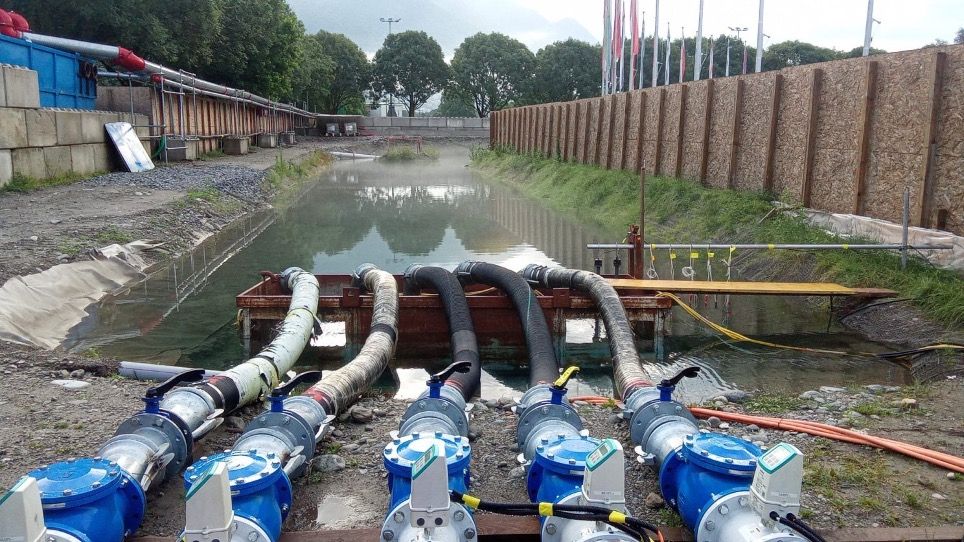
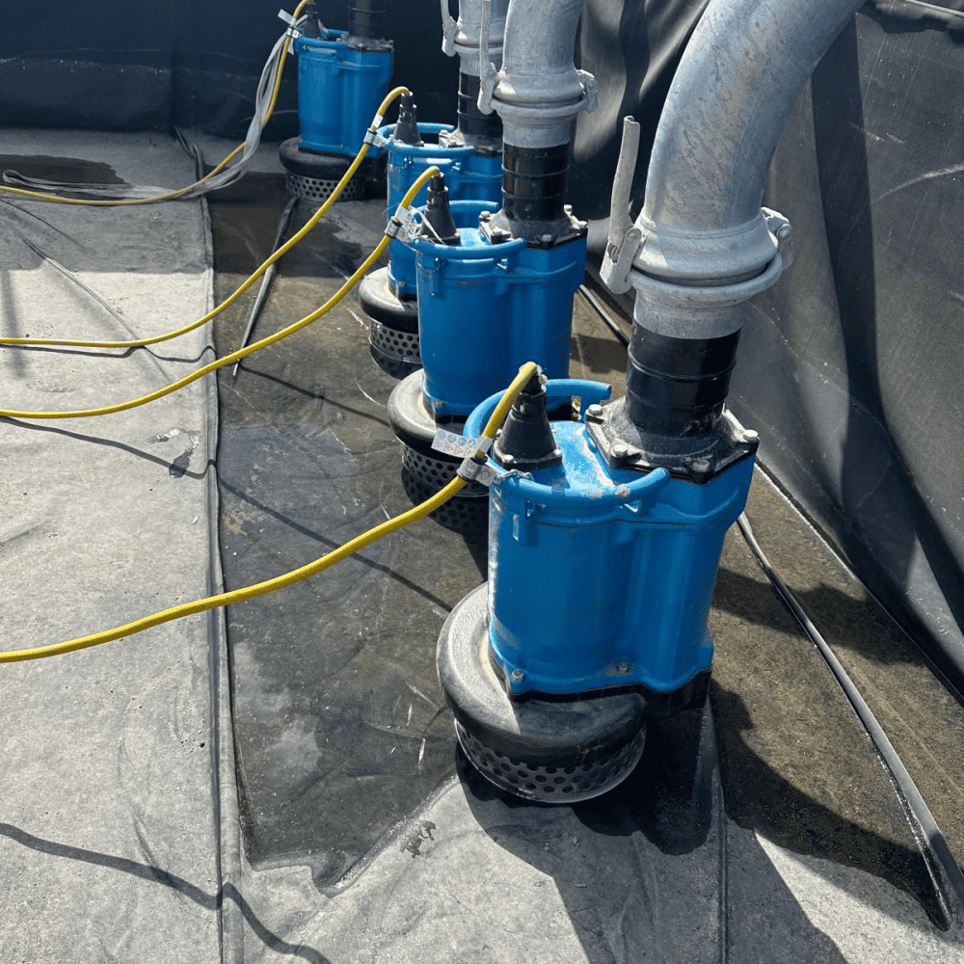
For flow rate management, submersible pumps TSURUMI KRS 2-69 (9 kW) were installed, with a total flow rate up to 8,000 l/min.
Regulation is achieved with butterfly valves on the discharge lines, integrated with a monitoring system that maintains balance with the hydrometric level of the nearby lake.
Pumped Water Treatment (3 phases)
-
Decantation: channeled to a tank about 300 m away, via 2 parallel galvanized steel pipes Ø 315 mm. Automatic control of turbidity and pH with possible recirculation if values are non-compliant.
-
Infiltration: passage through an infiltration tank to filter into the ground about 1,000 l/min, reducing the load on the final discharge.
-
Re-pumping and controlled discharge: tank with 5 submersible pumps TSURUMI KRS 2-89, equipped with level probes and electromagnetic meters, discharging to the lake via 2 parallel HDPE pipes.
For surface water at the excavation bottom, TSURUMI KTVE 33.7 submersible pumps were used, with dedicated treatment for neutralization and turbidity/pH control before release.
Automation and Monitoring
A PLC acquires real-time data on turbidity, pH, and flow rate and manages the entire system, improving reliability, traceability, and continuity.
Benefits for the construction site
The integrated Aquageo solution allowed for:
-
stable and controlled excavation drainage, suitable for highly permeable soils;
-
automated flow rate management with fine regulation and continuous monitoring;
-
treatment of extracted water in multiple stages (decantation, infiltration, re-pumping), with turbidity and pH control;
-
reduction of operational risk (instability, slowdowns, environmental non-compliance);
-
greater operational continuity thanks to PLC, sensors, and system redundancy.